

Prerequisites/dependencies
Windows OS and .NET 4
Introduction
Embrace this simple fact, we’re all owned. Maybe you
aren’t right now, but you probably were at some point or will be in the future.
“Assume compromise” is a stance I’ve long embraced, if you haven’t climbed
aboard this one-way train to reality, I suggest you buy a ticket. If headlines
over the last few years weren’t convincing enough, Mandiant’s APT1, Exposing One of China’s Cyber
Espionage Units report should serve as your re-education. As richly
detailed, comprehensive, and well-written as it is, this report is
groundbreaking in the extent of insights on our enemy it elucidates, but not necessarily
as a general concept. Our adversary has been amongst us for many, many years
and the problem will get much worse before it gets better. They are all up in
your grill, people; your ability to defend yourself and your organizations, and
to hunt freely and aggressively is the new world order. I am reminded, courtesy
of my friend TJ O’Connor, of a most relevant Patton quote: "a violently
executed plan today is better than a perfect plan expected next week." Be
ready to execute. Toolsmith has spent six and half years hoping to enable you,
dear reader, to execute; take the mission to heart now more than ever.
I’ve covered Mandiant tools before for good reason: RedCurtain in 2007,
Memoryze in 2009,
and Highlighter in 2011. I stand
accused of being a fanboy and hereby
render myself guilty. If you’ve read the APT1 report you should have taken
immediate note of the use of Redline and Indicators of Compromise (IOCs) in
Appendix G.
Outreach to Richard Bejtlich, Mandiant’s CSO, quickly
established goals and direction: “Mandiant
hopes that our free Redline tool will help incident responders find intruders
on their network. Combining indicators from the APT1 report with Redline’s
capabilities gives responders the ability to look for interesting activity on
endpoints, all for free.” Well in keeping with the toolsmith’s love of free
and open source tools, this conversation led to an immediate connection with
Ted Wilson, Redline’s developer, who kindly offered his perspective:
“Working side by
side with the folks here at Mandiant who are out there on the front lines every
day is definitely what has driven Redline’s success to date. Having direct access to those with firsthand
experience investigating current attack methodologies allows us stay ahead of a
very fast moving and quickly evolving threat landscape. We are in an exciting time for computer
security, and I look forward to seeing Redline help new users dive headfirst
into computer security awareness.
Redline has a
number of impressive features planned for the near future. Focusing first on expanding the breadth of
live response data Redline can analyze.
Some highlights from the next Redline release (v1.8) include full file
system and registry analysis capabilities, as well as additional filtering and
analysis tools around the always popular Timeline feature. Further out, we hope to leverage that
additional data to provide expanded capabilities that help both the novice and
the expert investigators alike.”
Mandiant’s Lucas Zaichkowsky, who will have presented on
Redline at RSA by the time you read this, sums up Redline’s use cases
succinctly:
1. Memory
analysis from a live system or memory image file. Great for malware analysis.
2. Collect
and review a plethora of forensic data from hosts in order to investigate an
incident. This is commonly referred to as a Live IR collector.
3. Create
an IOC search collector to run against hosts to see if any IOCs match.
He went further to indicate that while the second
scenario is the most common use case, in light of current events (APT1), the
third use case has a huge spotlight on it right now. This is where we’ll focus
this discussion to utilize the APT1 IOC files and produce a collector to
analyze an APT1 victim.
Installation and
Preparation
Mandiant provides quite a bit of material regarding
preparation and use of Redline including an extensive user guide, and two
webinars well
worth taking the time to watch. Specific to this conversation however, with
attention to APT1 IOCs, we must prepare Redline for a targeted Analysis Session. The concept here is
simple: install Redline on an analysis workstation and prepare a collector for
deployment to suspect systems.
To begin, download the entire Digital Appendix & Indicators archive
associated with the APT1 report.
Wesley McGrew (McGrew Security) put together a great blog
post regarding matching APT1 malware names to publicly available malware samples
from VirusShare (which is now the malware sample
repository). I’ll analyze a compromised host with one of these samples but
first let’s set up Redline.
I organize my Redline file hierarchy under \tools\redline with individual
directories for audits, collectors, IOCs, and sessions.
I copied Appendix G (Digital) – IOCs from the above mentioned download to APT1 under \tools\redline\IOCs.
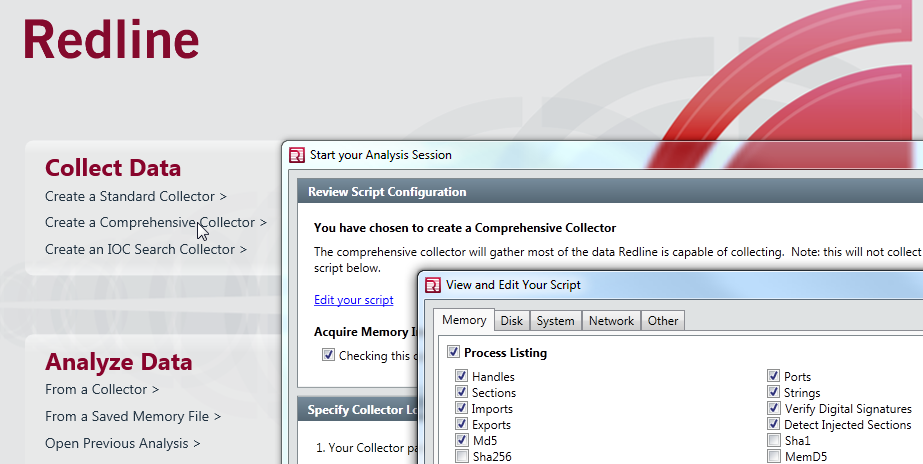
Open Redline, and select Create
a Comprehensive Collector under Collect
Data. Select Edit Your Script
and enable Strings under Process Listing and Driver Enumeration, and be sure to
check Acquire Memory Image as
seen in Figure 1.
 |
| Figure 1: Redline script configuration |
I saved the collector as
APT1comprehensive. These steps will add a lot of time to the collection
process but will pay dividends during analysis. You have the option to build an
IOC Search Collector but by default
this leaves out most of the acquisition parameters selected under Comprehensive Collector. You can (and
should) also add analysis inclusive of the IOCs after acquisition during the Analyze Data phase.
Redline, IOCs, and
a live sample
I grabbed the binary 034374db2d35cf9da6558f54cec8a455
from VirusShare, described in Wesley’s post as a match for BISCUIT malware. BISCUIT
is defined in Appendix C – The Malware
Arsenal from Digital Appendix &
Indicators as a backdoor with all the expected functionality including
gathering system information, file download and upload, create or kill
processes, spawn a shell, and enumerate users.
I renamed the binary gc.exe,
dropped it in C:\WINDOWS\system32, and executed it on a virtualized lab victim.
I rebooted the VM for good measure to ensure that our little friend from the
Far East achieved persistence, then copied the collector created above to the
VM and ran RunRedlineAudit.bat.
If you’re following along at home, this is a good time for a meal, walking the
dog, and watching The Walking Dead episode you DVR’d (it’ll be awhile if you
enabled strings as advised). Now sated, exercised, and your zombie fix pulsing
through your bloodstream, return to your victim system and copy back the
contents of the audits folder
from the collector’s file hierarchy to your Redline analysis station, select From a Collector under Analyze Data, and choose the copied audit as seen in Figure 2.
 |
| Figure 2: Analyze collector results with Redline |
Specify where you’d like to save
your Analysis Session (D:\tools\redline\sessions if you’re following my logic).
Let Redline crunch a bit and you will be rewarded with instant IOC goodness.
Right out of the gate the report details indicated that “2 out of my 47 Indicators
of Compromise have hit against this session.”
Sweet, we see a file hash hit
and a BISCUIT family hit as seen in Figure 3.
 |
| Figure 3: IOC hits against the Session |
Your results will also be
written out to HTML automatically. See Report
Location at the bottom of the Redline UI. Note that the BISCUIT family
hit is identified via UID a1f02cbe. Search a1f02cbe under your IOCs repository
and you should see a result such as D:\tools\redline\IOCs\APT1\a1f02cbe-7d37-4ff8-bad7-c5f9f7ea63a3.ioc.
Open the .ioc in your
preferred editor and you’ll get a feel for what generates the hits. The most
direct markup match is:
In the Redline UI, remember to
click the little blue button with the embedded i (information) associated with
IOC hit for highlights on the specific IndicatorItem
that triggered the hit for you and displays full metadata specific to the file,
process, or other indicator.
But wait, there’s more. Even
without defined, parameterized IOC definitions, you can still find other solid
indicators on your own. I drilled into the Processes
tab, and selected gc.exe,
expanded the selection and clicked Strings. Having studied Appendix D – FQDNs, and
checked out the PacketStash APT1.rules file
for Suricata and Snort (thanks, Snorby Labs), I went hunting (CTRL-F in the
Redline UI) for strings matches to the known FQDNs. I found 11 matches for
purpledaily.com and 28 for newsonet.net as seen in Figure 4.
 |
| Figure 4: Strings yields matches too |
Great! If I have alert udp $HOME_NET any -> $EXTERNAL_NET
53 (msg:"[SC] Known APT1 domain (purpledaily.com)";
content:"|0b|purpledaily|03|com|00|"…snipped enabled on my sensors I should see
all the other systems that may be
pwned with this sample.
Be advised that the latest
version of Redline (1.7 as this was written) includes powerful, time-related
filtering options including Field Filters, TimeWrinkle, and TimeCrunch. Explore
them as you seek out APT1 attributes. There are lots of options for analysis. Read the Redline Users Guide before
beginning so as to be full informed. J
In Conclusion
I’m feeling overly dramatic right now. Ten years now I’ve
been waiting for what many of us have known or suspected all along to be blown
wide open. APT1, presidential decrees, and “it’s not us,” oh my. Mandiant has
offered both the fodder and the ammunition you need to explore and inform, so
awake! I’ll close with a bit of the Bard (Ariel, from The Tempest):
While you here do
snoring lie,
Open-ey'd
Conspiracy
His time doth take.
If of life you keep
a care,
Shake off slumber,
and beware.
Awake, awake!
I am calling you to action and begging of your wariness;
your paranoia is warranted. If in doubt of the integrity of a system, hunt!
There are entire network ranges that you may realize you don’t need to allow access to or from your
network. Solution? Ye olde deny statement (thanks for reminding me, TJ). Time
for action; use exemplary tools such as Redline to your advantage, where
advantages are few.
Ping me via email if you have questions or suggestions
for topic via russ at holisticinfosec dot org or hit me on Twitter @holisticinfosec.
Cheers…until next month.
Acknowledgements
To the good folks at
Mandiant:
Ted Wilson, Redline developer
Richard Bejtlich, CSO
Kevin Kin and Lucas
Zaichkowsky, Sales Engineers


